Case study
LLM From Scratch
Hand-written decoder-only Transformer with causal attention and a Gradio teaching UI. Toy Shakespeare metrics only. Not a production LLM.
At a glance
Plain summary for recruiters and visitors. Technical detail follows below.
- What it is
- I built a tiny character-level language model by hand. You can see attention and next-character prediction without a library Transformer wrapper.
- What I owned
- Solo end to end. Tokenizer, attention, decoder LM, LSTM baseline, training loop, tests, and the Gradio teaching UI.
- Why it matters
- Makes the decoder rules inspectable. Causal mask, scaled attention, and next-token softmax on a toy corpus anyone can re-run.
- Try it on this page vs full project
- This page is the architecture story and published toy metrics. The interactive Gradio UI runs locally for hiring managers on request. A free Cloudflare playable demo is planned next.
Quick comparison
- Toy Transformer val loss
About 2.54 after 400 steps on the short Shakespeare excerpt.
- LSTM baseline
About 2.71 val loss on the same data and step budget.
Problem
Most LLM demos wrap a library Transformer or a hosted API. That hides the causal mask and attention math you need to debug and explain a decoder model.
Method
Implemented scaled dot-product attention and a Pre-LN decoder LM by hand. Trained a toy char model on a short Shakespeare excerpt. Added an LSTM baseline and a Gradio UI that shows the causal map and next-character bars.
Result
On the published toy holdout, Transformer val loss about 2.54 versus LSTM about 2.71 after 400 steps. The UI proves the mask and next-character softmax. Full training repo stays on request.
Architecture
How the system is shaped. Full implementation stays private.
Step 1
Tokens
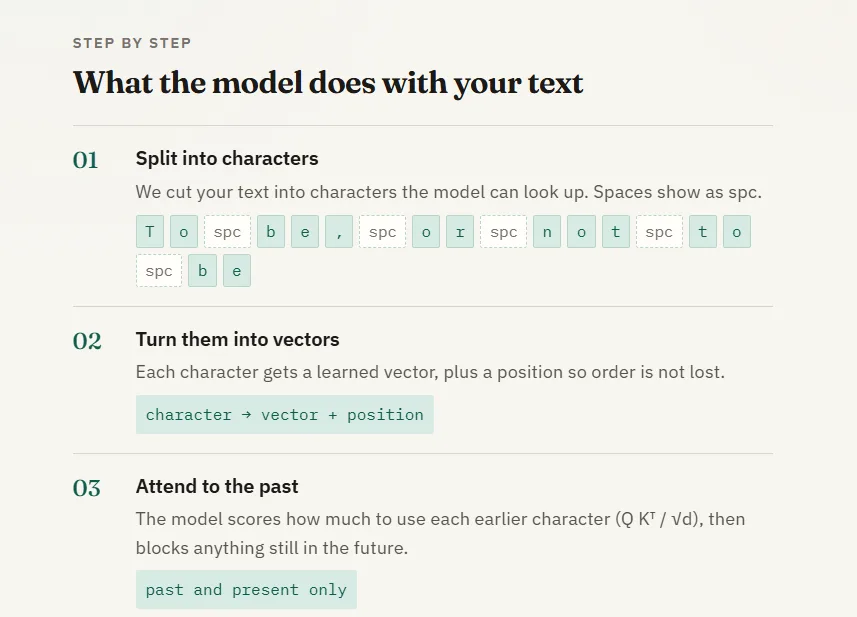
Character tokenizer over the training text. Small vocab so the UI can show each symbol, including spaces as spc.
Step 2
Attention
Scaled dot-product Q Kᵀ / √d_k with a lower-triangular causal mask before softmax. Multi-head merge and a linear output projection.
Step 3
Decoder LM
Pre-LN Transformer blocks with token and position embeddings, residual skips, and a tied output head for next-character logits.
Step 4
Teach and compare
Gradio UI walks prompt → causal map → next-character bars. An LSTM baseline trains on the same toy data for a lineage comparison.
Toy holdout loss (same corpus)
Character LM on a short public-domain Shakespeare excerpt. Both models train for 400 steps with block size 64 and seed 42. Numbers are educational. They are not a production LLM claim.
| Model | Val loss | Note |
|---|---|---|
| Decoder-only Transformer | 2.54 | Published toy |
| LSTM baseline | 2.71 |
Algorithm
Causal scaled dot-product attention
Score every past key for each query, hide the future with −∞, softmax, then mix values. That is the decoder-only LM rule.
scores = (Q @ K.T) / sqrt(d_k)
scores = mask_future(scores, fill=-inf)  # lower triangle only
weights = softmax(scores, dim=-1)
out = weights @ V
Key logic
Compact illustrative snippet (Causal mask before softmax (illustrative)). Not the full codebase.
def causal_mask(seq_len, device=None):
    return torch.tril(torch.ones(seq_len, seq_len, dtype=torch.bool, device=device))

scores = (q @ k.transpose(-2, -1)) / math.sqrt(d_k)
scores = scores.masked_fill(~mask, float("-inf"))
weights = F.softmax(scores, dim=-1)
Stack
Source code
Full source is available to hiring managers on request. The public page shows architecture, algorithms, and compact proofs only.